Searchers ask what a replacement costs in British Columbia and whether a very large bill is too much. Those questions are real. A dollar answer from this site would be invented, so it is not here. What you can sort out before the contractor arrives is the condition, the layers, the permit line, and whether the next covering should be Class A.
The local reasons a replacement comes up
About half of Kamloops homes were built before 1980. Many of those roofs are not original. They may be on a second asphalt layer, or they may still be wood shakes on a street that now backs onto grassland. The Housing Needs Report ties older stock to a higher chance of repairs. At some point the repair history is the argument for a tear-off.
Heat is the other quiet aging force. The Kamloops station's July average high is 29.3°C, with about 13.7 July days above 30°C. Asphalt that has lost its granules and cracks under that sun is a replacement candidate even if it has not leaked this week. The south hills add a different winter. The wildfire plan describes the slope south of downtown as north-facing, so snow can stay on shaded ground while the flats have melted. A replacement there should be talked through with the City's higher design snow load, not with the valley snowfall total of 63.1 cm.
Class A belongs in the conversation
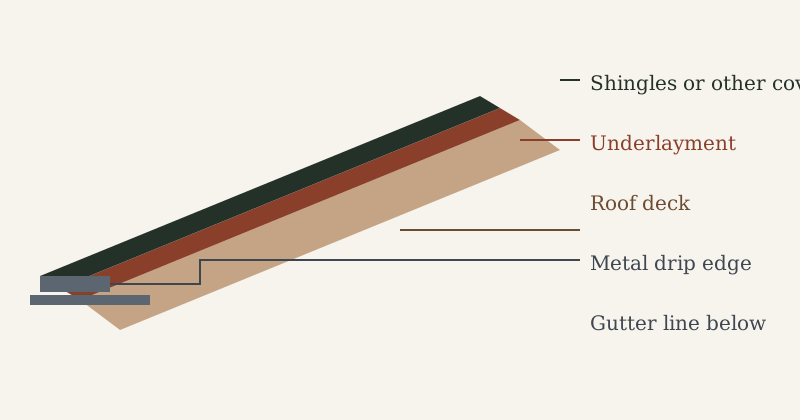
FireSmart BC's checklist says the roof covering and underlayment should have a Class A fire rating, and that roofing should not be wood shingles or shakes. It also asks for non-combustible flashing, sealed ridge ends on metal roofs, and a metal drip edge along eaves and rakes. In a city whose wildfire plan lists interface fires among the top hazards in a 2019 assessment, replacing like-for-like shakes is a choice you should have to make on purpose, not by habit.
Metal is one Class A path, not the only one. Rated asphalt and other rated coverings are on the FireSmart materials list too. The metal roofing page is for the hillside and interface streets where snow slide and ridge sealing are the specific questions. The FireSmart guide holds the full checklist so this page does not pretend to be the code.
The permit line is about load and structure
Bulletin 23-01 is plain. Reroofing that leaves the dead load and the slope alone does not, by that bulletin, need a building permit. Changing the pitch, or increasing the dead load, does. The bulletin's own examples are shakes to shingles, and shingles to clay or stone. New dormers, skylights, and solar panels are called out as structural roof work that needs a permit. A contractor who says "Kamloops never permits roofs" has skipped the bulletin. A contractor who insists on a permit for a same-weight shingle swap may also be wrong. The PDF is here: BLD Bulletin 23-01.
What to have ready when you call
- Neighbourhood, because snow zone and interface risk are not the same in Dallas and Juniper.
- Rough age of the house, and whether anyone has already roofed over an old layer.
- Photos of soft spots, stains, and the eave, taken from the ground if the roof is steep.
- Whether the goal is a leak that will not quit, a sale, or a move off wood shakes.
Replacement pages for individual neighbourhoods are limited to places with a distinct story: the south-hill interface in Sahali, Aberdeen, Batchelor Heights, Juniper Ridge, Pineview Valley, and Barnhartvale, and the older flats in North Shore, Brocklehurst, Westsyde, and Valleyview. Dallas, Rayleigh, and Mount Dufferin stay on their hubs plus this page.
Call (236) 836-0303 and describe the roof. You will get a connection to a local roofer, not a price read over the phone.
Straight answers
What is the average cost to replace a roof in BC?
This site does not answer that with a number. No current public Kamloops price list was used. Roof size, steepness, deck repairs, layers to remove, flashing, and the covering all move the quote. A local roofer has to see the house.
What is the most expensive part of replacing a roof?
There is no single line that is always the costly one. Tear-off and disposal, rotten decking, and custom flashing around chimneys and walls are the items that surprise people who budgeted for shingles only. Which of those shows up is a site fact, not a provincial average.
Do I need a permit to reshingle in Kamloops?
City bulletin 23-01 says reroofing that does not change dead load or slope does not need a building permit, and that changing the pitch or increasing dead load does. Structural work such as new dormers, skylights, or solar panels needs a permit. Confirm the job with the City if you are switching materials.