Call (236) 836-0303 and lead with the neighbourhood and whether the leak is active. A person may pick up. If not, an automated assistant takes your name, number, and a short description. Neither one can promise an arrival time. Kamloops Fire Rescue is not the roofing line. The City says five career fire stations are staffed around the clock and two on-call stations cover Rayleigh, Heffley Creek, Dallas, and Barnhartvale. That staffing is for fire and rescue. Use 911 for fire, structural collapse, or danger to a person. Use this site's number for a roof leak.
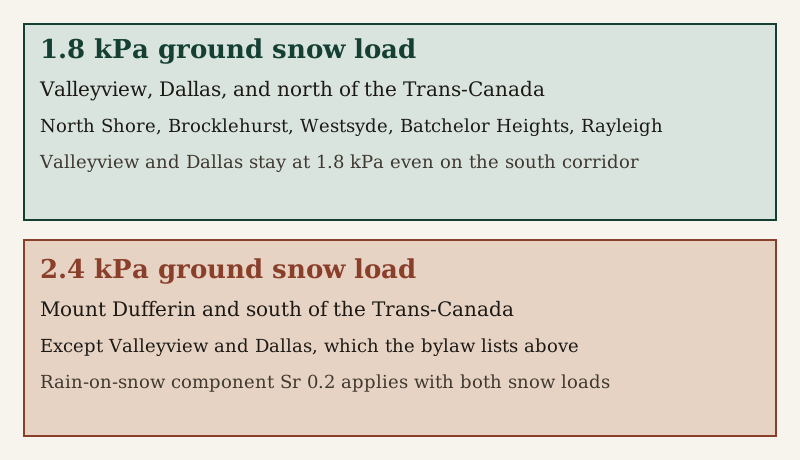
The two official ground snow loads
Building Regulation Bylaw No. 11-84 took effect on 1 April 2025. Part 28.1 says design climatic data for Kamloops comes from the current BC Building Code, Division B, Appendix C, plus the values in Part 28. Part 28.3 then sets the ground snow load:
- Ss 2.4 kPa at Mount Dufferin and south of the Trans-Canada Highway, except Valleyview and Dallas.
- Ss 1.8 kPa in Valleyview, Dallas, and north of the Trans-Canada Highway.
- Sr 0.2, the rain component that accompanies the snow load.
The consolidation shows an asterisk beside the two Ss values. Use the bylaw text, not this summary, if you are designing a building. A kilopascal is a pressure. It is not a depth. Wet snow and dry snow reach the same pressure at different thicknesses, so this page will not convert 2.4 kPa into centimetres. The asterisk and the code appendix are there so a designer accounts for the real situation on the member being built. They are not a prediction of next January on one address.
Part 28.2 uses the same geography for frost protection: 1.2 metres on Mount Dufferin and south of the highway, except Valleyview and Dallas, and 900 mm in Valleyview, Dallas, and north of the highway. Frost depth is a foundation rule. It is mentioned here only because it shows the City already treats that hillside as a different design place from the valley. It does not tell you how to patch a leak.
The legal consolidation is on the City's document site: Bylaw No. 11-84. The 2018 code appendix listed Kamloops at Ss 1.8 and Sr 0.2. This site does not treat that older table as the current snow rule, because the bylaw points at the current code edition and then writes its own Part 28 numbers.
What to do while you wait
Put a bucket under the drip. If you can reach the ceiling stain safely, move furniture. Photograph the roof from the ground, including any missing metal or a tree branch. Do not tarp a steep icy slope yourself. If the power is out or a tree is on the house, deal with the hazard first.
Wind damage has a local scale. The Kamloops normals show about 1.4 days a year at or above 63 km/h and an extreme gust of 98 km/h in the 1991 to 2020 period. A single gust can lift a ridge cap or a loose flashing. It does not mean the whole city needs new roofs the next morning. Describe what moved.
Snow is not the same emergency on every street
On the flats, the design load is the lower number and the valley station's January snow depth averages 7 cm. An emergency there is more often a sudden rain leak or a lifted shingle than a roof buried in a Sierra-style snowpack. On the south hills, shaded ground holds snow longer. Juniper Ridge, Sahali, Aberdeen, Pineview Valley, and Mount Dufferin are where a heavy wet fall plus the higher design load should make you cautious about adding a person on the roof. Batchelor Heights is north of the highway, so the bylaw number is 1.8 kPa, but it is still a hill where drifts form against the grassland. Valleyview and Dallas keep the lower number on purpose. Do not "correct" them to 2.4 because they sit east of downtown.
After the immediate leak is caught, use the ordinary repair or replacement page. Emergency work that leaves wood shakes in an interface neighbourhood has not finished the thinking. The FireSmart guide is the follow-up, not the thing you read while the ceiling is dripping.
Straight answers
Will a roofer arrive tonight?
No. This site will not invent a 24-hour crew. Call and say the leak is active, which neighbourhood you are in, and whether water is still coming in. A person or an automated assistant records the details for a local roofer. If a building is collapsing or someone is in danger, call 911.
Which snow load applies to my house?
Bylaw 11-84 sets 2.4 kPa for Mount Dufferin and south of the Trans-Canada, except Valleyview and Dallas, and 1.8 kPa for Valleyview, Dallas, and north of the highway. Sr is 0.2. A lot on the boundary, or a house in Barnhartvale, needs a reading of the bylaw against that property. These figures are design loads, not the depth of snow in your yard.
Should I climb up and pull the snow off?
Do not get on a snowy or icy roof to relieve a load you are worried about. Move what you can safely reach from the ground, catch the drip inside, and call. A fall is a worse emergency than a stain.